
Are you hiring for customer service? In customer experience, culture is everything — but culture isn’t built by systems. It’s built by people. And the truth is this: you cannot deliver exceptional customer care without hiring people who genuinely care.
Whether you’re bringing on your first assistant or expanding a full support team, the quality of your customer experience will only ever be as strong as the people who deliver it.
In this post, you’ll learn exactly how to hire, train, and empower a team that treats your customers with the same level of care you do.
Listen Here:
Resources:
Download Customer Success Kit → Grab the freebies (customer avatar workbook, customer focused business planner and complaint responses
Customer Experience Course → Enrol now
Customer Service Hiring Process
What makes someone great at customer service?
The best customer service team members share one essential trait: they are human-first.
Technical skills can be taught, but empathy, curiosity, emotional intelligence, and integrity must be hired for. These qualities determine how they treat your customers when nobody’s watching.
How to Hire for Exceptional Customer Care
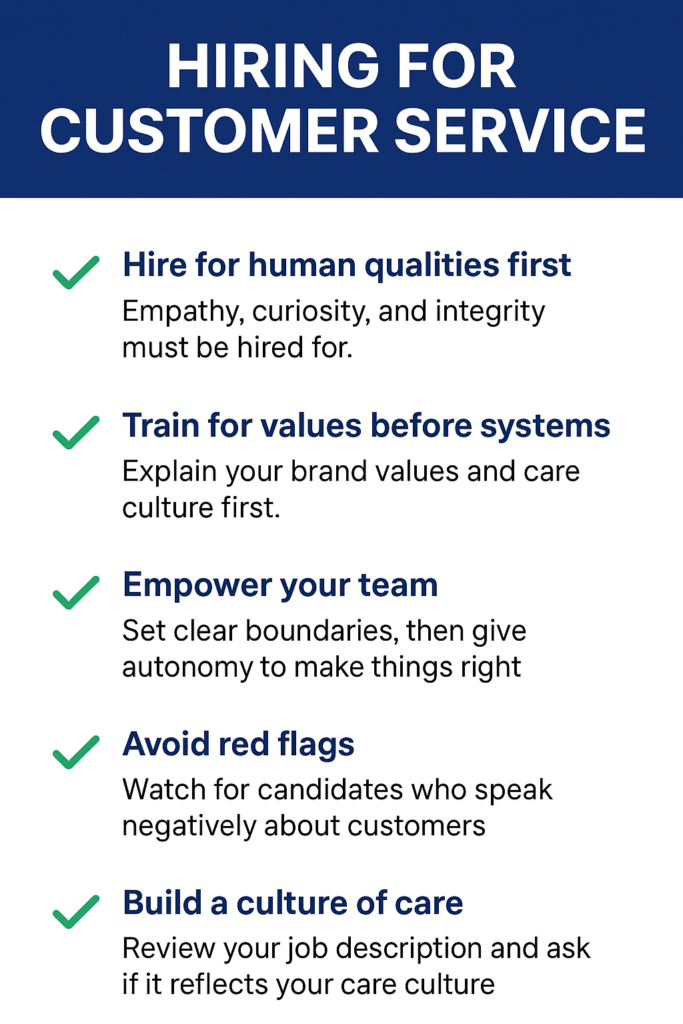
1. Hire for human qualities first
Most businesses make the mistake of prioritising efficiency, speed, and technical skill when hiring for customer service.
But the truth?
A polite, caring human who listens will outperform a fast, robotic problem-solver every single time.
During interviews, ask questions that reveal who they are, not just what they can do:
- “Tell me about a time you helped someone without being asked.”
- “What does great customer service mean to you?”
- “When was the last time you turned an unhappy customer around?”
These questions show how they think, how they behave under pressure, and whether they see customers as “tickets” or as real people.
2. Train for values before systems
Before you show a new hire the tools, the dashboard, or the inbox, you need to explain:
- What your brand stands for
- What “care” really means inside your business
- How you want customers to feel after interacting with your team
Values must come before software.
Your team can’t deliver the experience you envision unless they understand the emotional standard behind it.
3. Empower your team
A confident, empowered team reduces friction for customers and builds trust instantly. If you are looking for ways for how to empower your customer service team:
Set clear boundaries, yes — but give them autonomy to make things right.
A simple rule of thumb you can use:
If it costs less than £50 to fix, and it keeps the customer happy, empower your team to take action.
That small amount of freedom saves time, avoids bottlenecks, and creates loyal customers. You don’t want your team asking for their Manager every 2 minutes, this slows things down, looks unprofessional and can affect the customers experience.
If you would like to learn more about reducing the customers friction points – read this here.
4. Red flags to avoid when hiring
These are early warnings someone won’t be a fit for customer-focused roles:
- Speaking negatively about previous customers
- Prioritising “efficiency” over the customer experience
- Lack of curiosity about your audience or values
- No examples of human-centered problem-solving
- “Rules first” mindset instead of “care first” mindset
Remember: you’re not hiring someone to tick boxes — you’re hiring someone who will represent your brand.
5. Tools to support onboarding
Use your Customer Avatar Workbook from the free Customer Success Kit to help new hires understand:
- Who they’re serving
- What your customers value
- What your customers struggle with
- The emotional tone your brand delivers
This instantly improves consistency and confidence.
6. Build a culture of care
If you have an existing team, run a simple 15-minute “care huddle.”
Ask one powerful question:
“What does caring for our customers mean to you?”
You’ll be surprised by the insight, alignment, and connection it creates.
And if you’re still hiring? Review your job description and ask:
Does this reflect our care culture?
If it doesn’t — rewrite it until it does.
Frequently Asked Questions
Look for empathy, patience, curiosity, communication skills, and integrity. These cannot be trained — they must already exist in the person you hire.
Start with values and expectations, not tools. Teach them what care looks like in your business, give real examples, and show them how to make emotionally intelligent decisions.
Empathy helps team members understand the customer’s emotional state, respond compassionately, and resolve issues in a way that makes customers feel valued.
Set decision-making boundaries and allow them to fix small issues on the spot. Trust builds speed, confidence, and customer loyalty.
Look for candidates who naturally exhibit empathy, curiosity, and emotional intelligence. These qualities lead to better customer outcomes than technical skill alone.
Train them in your values, customer expectations, and emotional experience first. Systems training comes next.
Avoid candidates who speak negatively about customers, focus on speed over quality, or show no interest in your audience.
Give them clarity, autonomy, and simple guidelines for making things right quickly.
Top 10 Customer Service Interview Questions
Look for the candidate being human-first and they need to be care-centred.
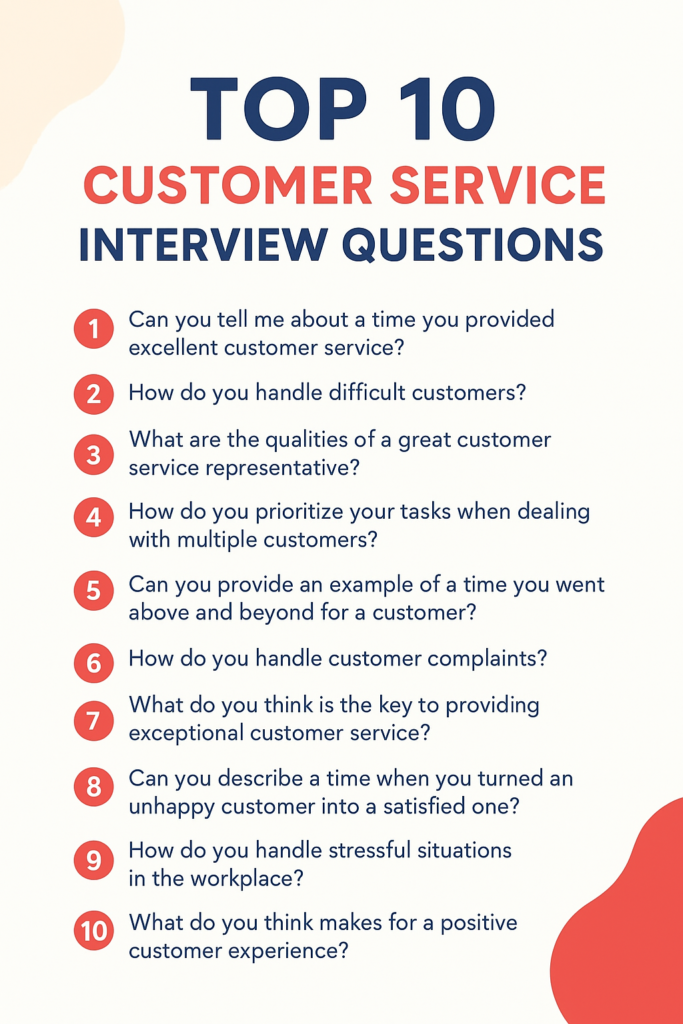
1. “Tell me about a time you helped someone without being asked.”
This reveals natural empathy, initiative, and intrinsic motivation — three traits you can’t train. These traits usually stem from how a person has been brought up by their family or friends surroundings.
2. “What does great customer care mean to you personally?”
You’ll hear whether they understand emotional experience vs. transactional service. I know we speak about statistics and issues being resolved within a certain amount of time…but, building rapport with a customer and resolving the issue is more important than the issue itself.
3. “Describe a situation where you turned around an unhappy customer. What did you do?”
Shows ownership, problem-solving, and emotional intelligence under pressure. Look for details in what steps they took, did they think of these steps themselves or where they told how to turn this customer around? Did it come naturally to them?
4. “When you don’t know an answer, how do you handle it?”
You’re looking for honesty + process (not bluffing or deflecting). It is better to say to a customer I am not sure how to resolve this, is it okay if I take this away and speak to my team and come back to you than to lie to the customer or make up the answer.
5. “Tell me about a time you had to work with someone who was frustrated or upset.”
Reveals calm communication skills and emotional maturity. Someone who is supportive, understands showing empathy and does not rise to anger or rudeness.
6. “How do you make customers feel valued, even during small interactions?”
Great candidates have clear, intentional behaviours (not vague clichés). They may show this through their personality, did they remember that this customer went on holiday last week and they asked them if they enjoyed themselves? This matters, this shows you care about their lives not just serving them.
7. “What do you think matters more: speed or connection? Why?”
Their reasoning tells you their underlying customer philosophy. Is it get the ticket resolved and the queue in control or are they looking to make sure their customer is fully satisfied with the resolution given? Did they go the extra mile giving assistance?
8. “What do you need from a manager to do your best work in customer care?”
You’ll uncover whether they thrive in structured support, autonomy, or collaboration. This will show whether they will fit in with your team and potentially you as a manager. Will you need to adapt your management ways in order to support this candidate fully? This is fine, but it is definitely helpful to know upfront.
Personally I thrive with space, I need to be allowed to manage my workload and customers and report to my manager. WHY? Because I know what I am doing to serve the customers with the best service. A manager without experience in customer care would potentially steer me away from the best service I can give. Trust your staff and who you have hired to do the best job they can do. Then give support/training when needed.
9. “Tell me about a time you disagreed with a policy. What did you do?”
Shows alignment with care culture, boundaries, and problem-solving beyond rules. Did they make a good call? Or did they completely step over the line and potentially upset other customers in doing so?
10. “How do you learn a new audience or customer type?”
You want curiosity. Curiosity = better support, better understanding, better decisions. And don’t forget my Customer Avatar Workbook which guides you to outlining exactly who your audience/customers actually are.
I can create any of these if you want them.